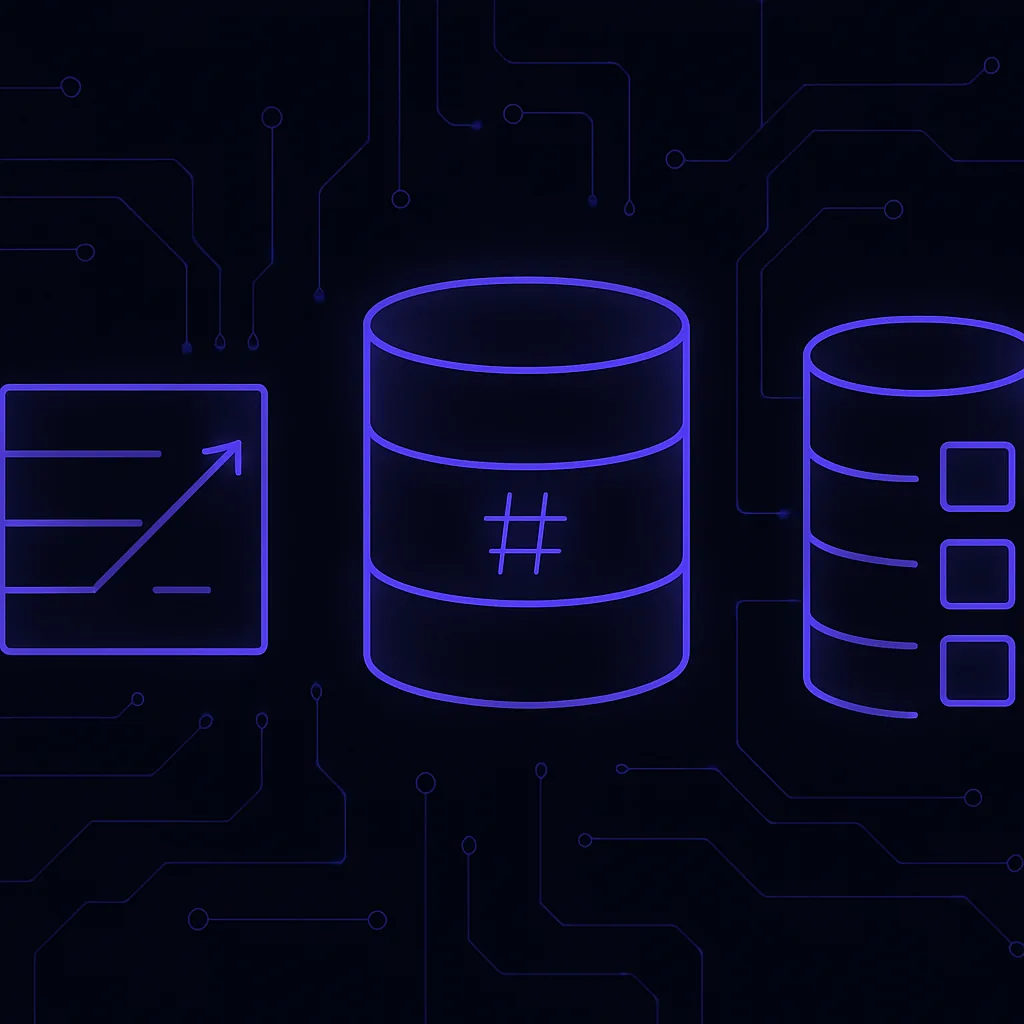
Mastering Data Partitioning Strategies: Range, Hash, and List Partitioning
In the ever-evolving landscape of software architecture, data partitioning has emerged as a critical strategy for scaling databases and improving performance. As we move into 2025 and beyond, the demand for efficient data management in cloud-native environments continues to grow. This blog post delves into three primary data partitioning strategies—Range, Hash, and List Partitioning—offering insights into their applications, benefits, and challenges.
Why Data Partitioning Matters Now
With the proliferation of microservices and the shift towards distributed systems, managing large datasets efficiently is more crucial than ever. Data partitioning allows systems to handle increased loads by distributing data across multiple nodes, thus enhancing performance and reliability. As organizations increasingly adopt cloud platforms, understanding and implementing effective partitioning strategies is essential for optimizing resource utilization and ensuring seamless scalability.
Deep Dive into Partitioning Strategies
Range Partitioning
Range partitioning involves dividing data into contiguous ranges based on a specified key. This strategy is particularly effective when dealing with time-series data or any dataset where queries are often range-based.
Example:
Consider a database storing user activity logs. Using range partitioning, you might partition the data by date:
CREATE TABLE user_activity (
    user_id INT,
    activity_time TIMESTAMP,
    activity_details TEXT
) PARTITION BY RANGE (activity_time);

CREATE TABLE user_activity_2025 PARTITION OF user_activity
    FOR VALUES FROM ('2025-01-01') TO ('2026-01-01');
Pros:
- Efficient for range queries.
- Simplifies data archiving and purging.
Cons:
- Uneven data distribution if ranges are not well-defined.
- Potential hotspots if most queries target a specific range.
Hash Partitioning
Hash partitioning distributes data based on the hash value of a partition key. This approach ensures even data distribution, making it ideal for scenarios where queries are uniformly distributed across the dataset.
Example:
For a user database, you might partition by user ID:
CREATE TABLE users (
    user_id INT,
    user_name TEXT,
    email TEXT
) PARTITION BY HASH (user_id);

CREATE TABLE users_part_1 PARTITION OF users
    FOR VALUES WITH (MODULUS 4, REMAINDER 0);
Pros:
- Uniform data distribution.
- Reduces risk of hotspots.
Cons:
- Not suitable for range queries.
- Repartitioning can be complex if the hash function changes.
List Partitioning
List partitioning assigns data to partitions based on a predefined list of values. This strategy is useful when dealing with categorical data.
Example:
For a product catalog, you might partition by product category:
CREATE TABLE products (
    product_id INT,
    category TEXT,
    price DECIMAL
) PARTITION BY LIST (category);

CREATE TABLE electronics PARTITION OF products
    FOR VALUES IN ('Electronics');
Pros:
- Tailored to specific categorical queries.
- Simplifies management of distinct data categories.
Cons:
- Requires predefined categories.
- Not flexible for dynamic or new categories.
Real-World Use Cases and Architecture Patterns
Microservices and Data Partitioning
In a microservices architecture, each service might manage its own database. Partitioning strategies can be applied within each service to enhance performance and scalability. For instance, an e-commerce platform might use range partitioning for order history and hash partitioning for user accounts.
Cloud-Native Applications
Cloud providers offer managed database services that support partitioning. Leveraging these services allows teams to focus on application logic while the cloud handles data distribution and scaling.
Common Mistakes Engineers Make
- Over-partitioning: Creating too many partitions can lead to management overhead and degraded performance.
- Ignoring future growth: Failing to anticipate data growth can result in uneven partition sizes and hotspots.
- Inadequate monitoring: Without proper monitoring, it's challenging to identify and address partitioning issues.
When NOT to Use This Approach
- Small datasets: The overhead of partitioning may outweigh the benefits for small datasets.
- Highly dynamic schemas: Frequent schema changes can complicate partition management.
- Simple applications: For straightforward applications, partitioning might introduce unnecessary complexity.
How This Impacts System Design Interviews
Understanding partitioning strategies is crucial for system design interviews, especially for roles focused on scalability and performance. Candidates should be prepared to discuss trade-offs and justify their choice of partitioning strategy based on specific use cases.
Best Practices and Recommendations
- Analyze query patterns: Choose a partitioning strategy that aligns with your most common query patterns.
- Plan for growth: Design partitions with future data growth in mind to avoid frequent repartitioning.
- Leverage cloud services: Utilize managed services for automated scaling and partition management.
Future Outlook
As data volumes continue to grow, partitioning strategies will evolve to address new challenges. Innovations in AI and machine learning may lead to more intelligent partitioning algorithms that dynamically adjust based on usage patterns.
Conclusion
Data partitioning is a powerful tool for optimizing database performance and scalability. By understanding the nuances of range, hash, and list partitioning, engineers can design systems that efficiently handle large datasets in today's cloud-native world. As you implement these strategies, consider the specific needs of your application and the trade-offs involved to ensure a robust and scalable architecture.